
Recreating a binder’s volume: Rosalie Raymond
In Christopher Newport University’s Special Collections in Triple Library lies hundreds of pieces of sheet music items collected by Josephine Lane Hughes (1896-1976). All of these were found in Charleston, SC and came together as she amassed material for her antiques business–even Lester Levy mentioned her collection of music in his 1976 articles about music collections around the United States. (Lester S. Levy, “Recollections of a Sheet Music Collector.” Notes 32, no. 3 (1976): 491–502. (492) https://doi.org/10.2307/897987) Almost all of this collection lies in folders cataloged by title, with a spreadsheet to guide the researcher through its contents.
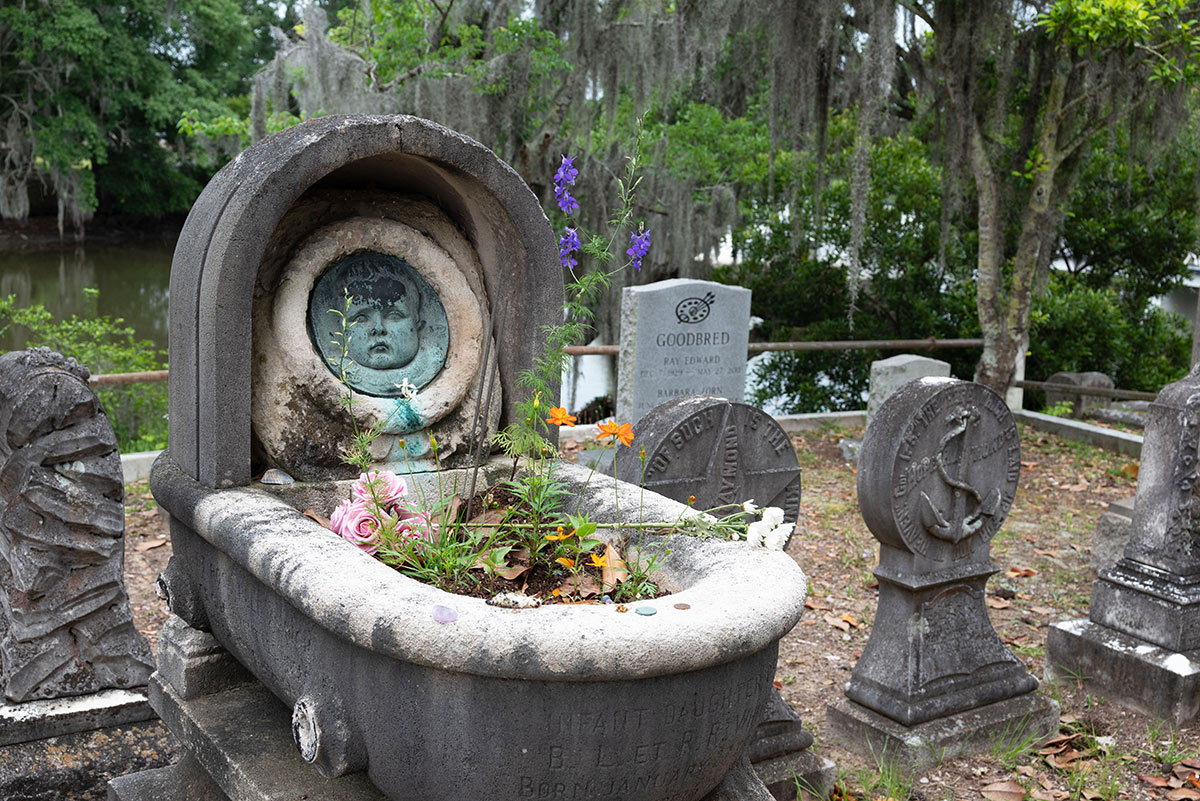
Happily, because it is not a very large collection, I have been able to piece some of the bits together and find two previously bound volumes that belonged to Rosalie Raymond [White] (1857-1933). A native Charlestonian, she is most famous for the poignant memorial to her infant daughter that has become the image most people associate with the Magnolia Cemetery. (Image by Joey Izzo from https://charlestoncitypaper.com/2024/05/24/the-haunting-beauty-of-magnolia-cemetery/)
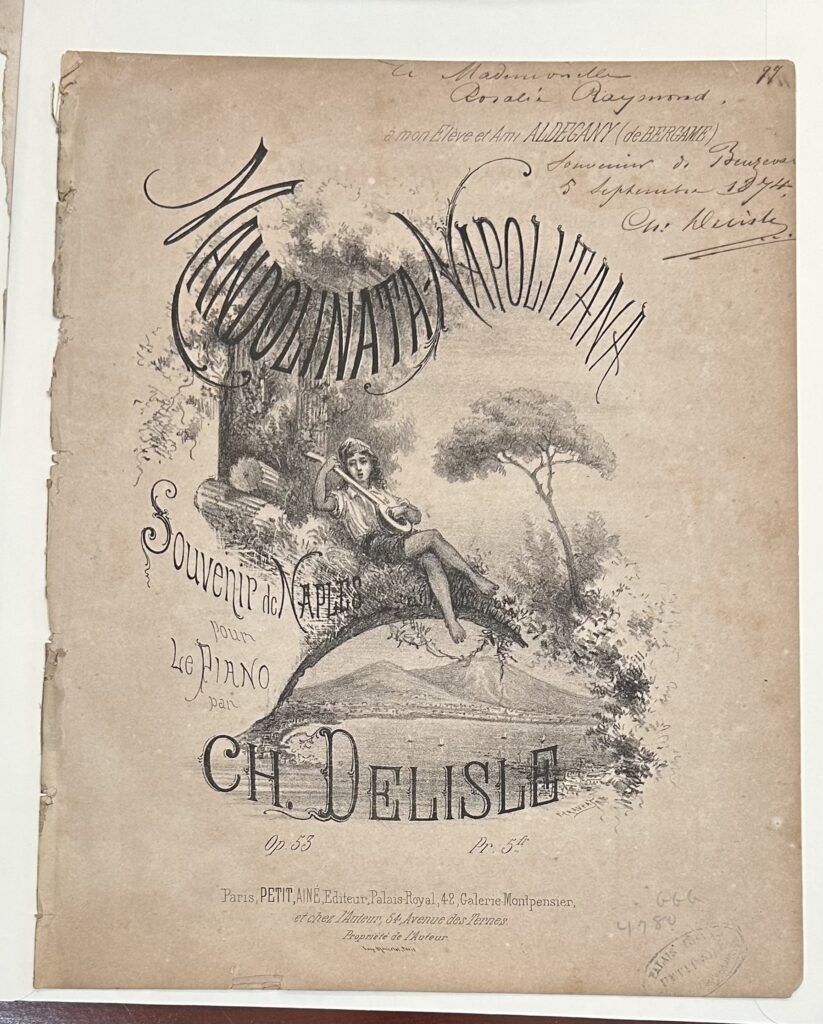
I was able to align holes where the pages had been sewn together, page numberings, and other physical evidence, thus recreating a collection that had been bound together only temporarily. The original buyers of the music, Rosalie’s extended family in France, had not brought the music into a single entity. Instead, they had gifted the sheet music to Rosalie as she visited them in the 1870s. She wrote the place, date, and even the names of the people who had presented her with this music, and sometimes commented on the occasion. In later years (the 1890s), she revisited it and made additional notes on the music. The first image below shows a gift from the composer Charles deLisle to Rosalie (dated 1874). The second image has her initials “R. R.” in ink at the top (from the 1870s) and her additional notes in pencil underneath (1890s).

At some point, Rosalie had this music bound into two albums, one oblong and one upright, as suited the music itself. I had been intrigued about the two levels of commentary I found, and as I re-created these binder’s volumes, I was able to piece together items from Rosalie’s biography that suggested to me her reasons for marking them. I describe these in a forthcoming chapter on a book about “albuming” (edited by Halina Goldberg and Henrike Ross), where I explore the idea that Rosalie used the music in these two binder’s volumes as lieux de mémoire–holders of memories–of her past, her family’s past, and even that of the “Old South” (pre-Civil War).
Many more now disbound binder’s volumes could be put back together if we had the luxury of time and space to do so. Perhaps library’s will consider this possibility in the future?
